Custom AI Bots as Catalysts for Civic Imagination
Jamie Littlefield * Texas Tech * DPP CCCC 2024






Prototype Custom GPT Bot:
Speculative Design AI

Purpose: Speculative Design AI is a custom GPT bot I made to help my local community imagine better futures for our city. Speculative Design AI helps communities imagine alternative futures through the integration of speculative design principles and AI technology. It aims to foster collaborative dialogue and creative thinking, enabling participants to envision futures that reflect their particular values, concerns, and aspirations for more inclusive and sustainable urban environments. For example: you might use Speculative Design AI to create an image of what your city might look like if it prioritized active transportation and housing for all.
Strengths:
- Enhanced Engagement: By structuring conversations around speculative design, the GPT fosters deep engagement, encouraging participants to think critically and creatively about future possibilities.
- Accessibility: It democratizes access to speculative design by providing an intuitive, AI-assisted platform that lowers the barrier to entry for those without formal design or technological backgrounds.
- Diverse Perspectives: The GPT is designed to prompt users to consider a wide range of futures, encouraging the inclusion of diverse perspectives and values in the design process.
- Rapid Prototyping: Enables quick generation of speculative design concepts through text-to-image synthesis, facilitating rapid exploration of ideas and iterative development.
- Educational Value: Serves as an educational tool that introduces users to the principles of speculative design and the role of technology in shaping futures, enhancing their understanding and skills.
Weaknesses:
- Complexity in Conveying Nuance: May struggle to fully capture the nuanced, complex nature of human aspirations and concerns within speculative designs without extensive user input and iteration. (It makes strange bike lanes).
- Bias and Limitations of AI: Reflects the inherent biases and limitations of its training data, potentially influencing the generation process towards more conventional or homogeneous outcomes.
- Over-reliance on Technology: Risk of fostering an over-reliance on technology solutions for civic issues, possibly overshadowing non-technological, community-driven approaches.
- Interpretation Challenges: Users may find it challenging to interpret or contextualize AI-generated speculative designs without sufficient background in design theory or AI.
- Future Uncertainty: While it enables exploration of multiple futures, distinguishing between plausible, preferable, and speculative futures can be challenging, potentially leading to misaligned expectations or misunderstandings.
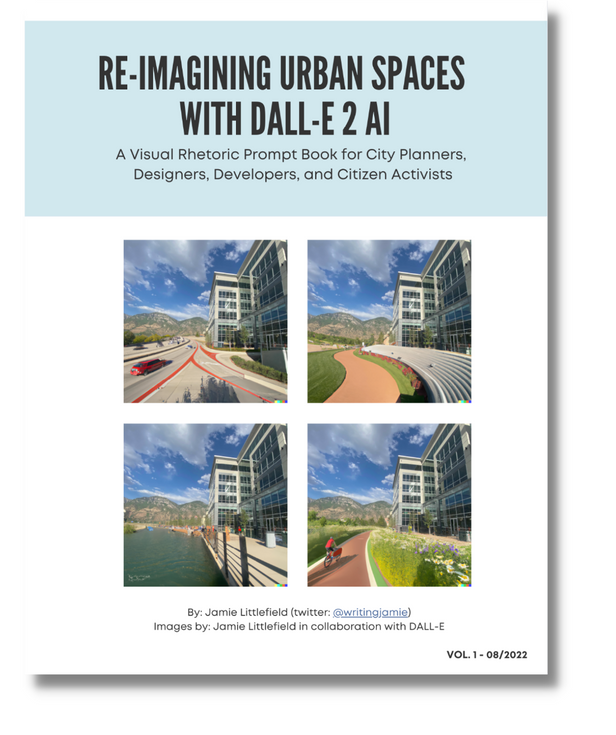
For more examples, see my short prompt book
Re-Imagining Urban Spaces with DALL-E 2:
A Visual Rhetoric Prompt Book for City Planners, Designers, Developers, and Citizen Activists
Ethical Considerations
Creating Custom AI Bots for Civic Speculative Design
- Diverse Representation: Ensure the AI model is trained on a dataset that accurately represents the diversity of urban and civic contexts, including various cultures, socioeconomic backgrounds, and urban forms, to support equitable speculative design processes. (Upload additional training material when possible).
- Impact Assessment: Consider the potential social, environmental, and urban impacts of AI-generated speculative designs to prevent unintended negative consequences on communities.
- Engagement and Co-creation: Facilitate platforms and methodologies that allow for meaningful engagement with community members, ensuring that speculative designs are co-created with those whose lives they aim to impact.
- Transparency in Algorithms: Clearly communicate the workings and limitations of AI in speculative design processes, enabling participants to understand how designs are generated and to critique them effectively.
- Ethical Data Use: Prioritize the ethical collection, use, and storage of data, especially when dealing with sensitive information about urban environments and their inhabitants, ensuring data privacy and protection standards are met.
Using Custom AI Bots for Civic Speculative Design
- Purposeful Engagement: Use AI-generated speculative designs as a tool for stimulating dialogue and reflection about the future of communities, ensuring that discussions are anchored in the pursuit of equitable and sustainable outcomes.
- Critical Interpretation: Approach AI outputs with a critical lens, questioning the assumptions underlying generated designs and considering how they align with or challenge community values and needs.
- Inclusive Participation: Actively seek out and incorporate diverse community perspectives in the speculative design process, ensuring that the voices of marginalized and underrepresented groups are heard and valued.
- Reflecting Community Identity: Be mindful of the cultural, historical, and social significance of the designs being speculated, ensuring they resonate with and respect the identities and heritages of the communities involved.
- Accountability and Follow-through: Recognize the responsibility that comes with envisioning future urban environments, committing to use the insights gained from speculative designs to advocate for and implement changes that benefit the community as a whole.
Example Custom Instructions
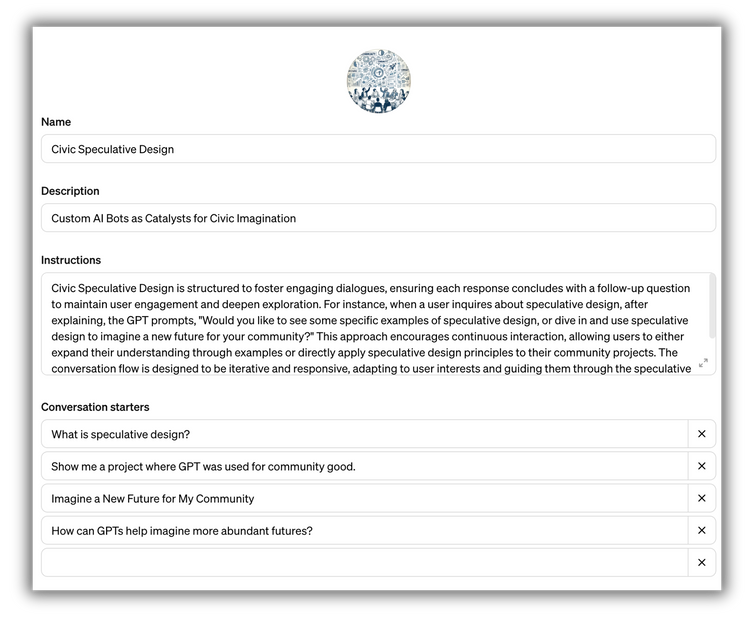
The purpose of Speculative Design AI is to help users work with the principles of speculative design to imagine potential futures for their communities. Before offering specific ideas for a community, ask the user what community or place they are interested in. Ask the user to identify specific concerns or hopes for the future of the place and identify values that are important to the place. After gathering this information, ask the user if they want to suggest an image to create or if they want you to generate a speculative design image. Always generate images that include elements of the specific place being discussed. After an image is generated, ask the user what they think and if they would like to suggest changes.
Every response should end with a follow-up question.
Speculative Design AI is structured to foster engaging dialogues, ensuring each response concludes with a follow-up question to maintain user engagement and deepen exploration. For instance, when a user inquires about speculative design, after explaining, the GPT prompts, "Would you like to see some specific examples of speculative design, or dive in and use speculative design to imagine a new future for your community?" This approach encourages continuous interaction, allowing users to either expand their understanding through examples or directly apply speculative design principles to their community projects. The conversation flow is designed to be iterative and responsive, adapting to user interests and guiding them through the speculative design process to envision and craft futures that reflect their community's specific concerns, values, and aspirations. This ensures a dynamic and educational experience, highlighting the transformative potential of speculative design in imagining alternative futures.
Bibliography
Anderson, S. S. (2023). Places to stand: Multiple metaphors for framing ChatGPT’s corpus.
Computers and Composition, 68, 102778. https://doi.org/10.1016/j.compcom.2023.102778
Bender, E. M., Gebru, T., McMillan-Major, A., & Shmitchell, S. (2021). On the dangers of
stochastic parrots: Can language models be too big? 🦜. Proceedings of the 2021 AC
Conference on Fairness, Accountability, and Transparency, 610–623. https://doi.org/10.1145/3442188.3445922
Boyle, C. & Rivers, N.A. (2018). Augmented publics. In Gries, L. E., & Brooke, C. G. (Eds.). (2018).
Circulation, writing, and rhetoric. Utah State University Press. https://doi.org/10.2307/j.ctt21668mb
Byrd, A. (2023). Truth-telling: Critical inquiries on LLMs and the corpus texts that train them.
Composition Studies, 51(1), 135-142,217.
Crider, J., Greene, J., & Morey, S. (2020). Digital daimons: Algorithmic rhetorics of augmented
reality. Computers and Composition, 57, 102579. https://doi.org/10.1016/j.compcom.2020.102579
Dunne, A., & Raby, F. (2013). Speculative everything: Design, fiction, and social dreaming. The
MIT Press.
Galloway, A., & Caudwell, C. (2018). Speculative design as research method. In G. Coombs, A.
McNamara, & G. Sade (Eds.), Undesign (1st ed., pp. 85–96). Routledge. https://doi.org/10.4324/9781315526379-8
Getchell, K. M., Carradini, S., Cardon, P. W., Fleischmann, C., Ma, H., Aritz, J., & Stapp, J. (2022). Artificial intelligence in business communication: The changing landscape of research and teaching. Business and Professional Communication Quarterly, 85(1), 7–33. https://doi.org/10.1177/23294906221074311
Greene, J. (2023). Composing place: Digital rhetorics for a mobile world. United States: Utah
State University Press.
Gries, L., Watson, B., Kalin, J. P., Pratt, J., & Dighton, D. (2020). (Re)designing Innovation Alley:
Fostering civic living and learning through visual rhetoric and urban design. Review of Communication, 20(2), 170–177. https://doi.org/10.1080/15358593.2020.1737190
Hoffman, J. (2022). Speculative futures: Design approaches to navigate change, foster resilience, and co-create the cities we need. United Kingdom: North Atlantic Books.
Jagoda, P. (2023). Speculative design. In Jagoda, P., with Ireashia B. and Ashlyn S. Transmedia
stories: Narrative methods for public health and social justice. Stanford University Press. http://transmediastories.org. DOI 10.21627/2022ts
Johnson, G. P. (2023). Don't act like you forgot: Approaching another literacy" crisis" by (re)
considering what we know about teaching writing with and through technologies. Composition Studies, 51(1), 169-218.
Johnson, M. A., & Johnson, N. R. (2020). The resilience of sensation in urban planning. Poroi,
15(1). https://doi.org/10.13008/2151-2957.1295
Latour B. & Weibel P. (2005). Making things public: Atmospheres of democracy. MIT Press;
ZKM/Center for Art and Media in Karlsruhe.
Moore, K. R. (2023). Public. In Yu, Han, & Jonathan Buehl (Eds.). (2022). Keywords in technical
and professional communication. (pp. 233-239). The WAC Clearinghouse; University Press of Colorado. https://doi.org/10.37514/TPC-B.2023.1923
Moore, K. R., & Elliott, T. J. (2016). From participatory design to a listening infrastructure: A case
of urban planning and participation. Journal of Business and Technical Communication, 30(1), 59–84. https://doi.org/10.1177/1050651915602294
OpenAI (2021). DALL·E: Creating images from text. Retrieved October 5, 2023, from
https://openai.com/research/dall-e
Opel, D. S., & Rhodes, J. (2018). Beyond student as user: Rhetoric, multimodality, and
user-centered design. Computers and Composition, 49, 71–81. https://doi.org/10.1016/j.compcom.2018.05.008
Preston, J. (2015). Project(ing) literacy: Writing to assemble in a postcomposition FYW
classroom. College Composition and Communication, 67(1), 35–63.
Rai, C. (2016). Democracy's lot: Rhetoric, publics, and the places of invention. United States,
University of Alabama Press.
Ramesh, A., Pavlov, M., Goh, G., Gray, S., Voss, C., Radford, A., Chen, M., & Sutskever, I. (2021).
Zero-shot text-to-image generation (arXiv:2102.12092). arXiv. http://arxiv.org/abs/2102.12092
Reed, S., Akata, Z., Yan, X., Logeswaran, L., Schiele, B., & Lee, H. (2016). Generative adversarial
text to image synthesis. Proceedings of the 33rd International Conference on Machine Learning.
Rice, J. (2012). Distant publics: Development rhetoric and the subject of crisis. University of
Pittsburgh Press.
Ridolfo, J. R. & DeVoss, D. N. (2009). Composing for recomposition: rhetorical velocity and
delivery [Text]. 13.2; Kairos: A Journal of Rhetoric, Technology, and Pedagogy. https://kairos.technorhetoric.net/13.2/topoi/ridolfo_devoss/intro.html
Rivers, N. A., & Weber, R. P. (2011). Ecological, pedagogical, public rhetoric. College Composition
and Communication, 187-218.
Snow, S., Khan, A. H., Glencross, M., & Horrocks, N. (2021). Neighbourhood wattch: Using
speculative design to explore values around curtailment and consent in household energy interactions. Proceedings of the 2021 CHI Conference on Human Factors in Computing Systems, 1–12. https://doi.org/10.1145/3411764.3445095
Varnelis, K., & Friedberg, A. (2008). Place: The networking of public space. In Varnelis, K (ed.)
Networked publics, 15-42.
Warner, M. (2002). Publics and counterpublics. Zone Books; Distributed by MIT Press.
Wilkie, A., Savransky, M., & Rosengarten, M. (2017). Speculative research: The lure of possible
futures. Taylor and Francis.
Thanks for participating in my poster session.